
US Army Nurse Scientist Major Julia G. Catanese, PhD, MSN, RN, CNOR, CHSE, and colleagues recently published a systematic review titled “Assessing and evaluating computer-based simulation for scrub role training: A systematic review framed by Miller’s Pyramid of clinical competence.” Their study examined the evidence behind computer-based simulation (CBS) for scrub role education.
Published in ScienceDirect and Clinical Simulation in Nursing, the systematic review examined research published between 2019 and 2024 to understand both how computer-based simulation outcomes are assessed and how effectively simulation develops scrub role competence. Nine studies met the review’s inclusion criteria, with outcomes assessed through multiple-choice tests, in-game performance metrics, and objective structured clinical examinations.
The review found that “CBS strengthened knowledge, knowledge application, and performance in simulated settings comparable to or better than traditional training across the Knows, Knows How, and Shows How levels of Miller’s Pyramid.”
The authors found moderate to moderately high methodological quality across the studies, providing reasonable confidence that the observed improvements represented actual learning gains. Several studies also suggested that computer-based simulation may help slow skill decay and support more durable performance compared with traditional training alone.
Why Scrub Role Training Matters
The scrub role, performed by Surgical Technologists (STs) and Perioperative Registered Nurses (RNs), plays an important role in surgical safety and patient outcomes. Scrub professionals support more than 300 million surgeries globally each year, including an estimated 40 to 50 million in the United States (Dobson, 2020).
Their responsibilities extend far beyond knowing surgical instruments. Scrub personnel prepare the operating room, establish and maintain the sterile field, anticipate procedural steps, pass instruments, respond to changing operative conditions, and help identify and intercept potential safety issues (Phillips & Hornacky, 2016; Shields et al., 2023).
The review notes that experienced scrub personnel can reduce operative time (Cheng et al., 2018; Di Costa et al., 2025), while case reviews demonstrate their role in intercepting near misses involving sterile technique, instrument sterilization, surgical counts, specimen handling, and equipment failures (Stucky et al., 2024).
Traditionally, much of this expertise has been developed through classroom instruction followed by clinical apprenticeship and “double scrubbing”— learning alongside experienced professionals during live surgical cases.
Simulation creates an opportunity to augment this model by allowing Learners to practice important scrub role tasks and scenarios outside the live OR, without putting patients at risk (Kaldheim et al., 2019; Khorammakan et al., 2023). Computer-based simulation is already being used to teach skills including instrument handling, sterile field setup, and procedure sequencing.
From Knowing to Showing How
One of the most interesting aspects of Catanese et al.’s review is its use of Miller’s Pyramid of Clinical Competence to evaluate the evidence.
The framework describes four progressive levels of clinical competence:
- Knows — foundational knowledge
- Knows How — applying that knowledge
- Shows How — demonstrating performance in a controlled environment
- Does — performing in real-world clinical practice
The systematic review found evidence supporting computer-based simulation across the first three levels.
Across the studies reviewed, computer-based simulation improved knowledge, application, and simulated performance—supporting Learners as they progress from Knows to Knows How to Shows How.
Five studies assessed participant performance in controlled simulated settings, corresponding to Miller’s Shows How. One of these studies examined the use of PeriopSim among nurses, who “scored significantly higher on the OSCE.” Those who received “simulation training were 23% quicker in identifying real instruments and did so with better accuracy (93.2% vs 80.6%, p<0.0001)” — demonstrating improved performance in a controlled environment (Clarke et al. 2021).
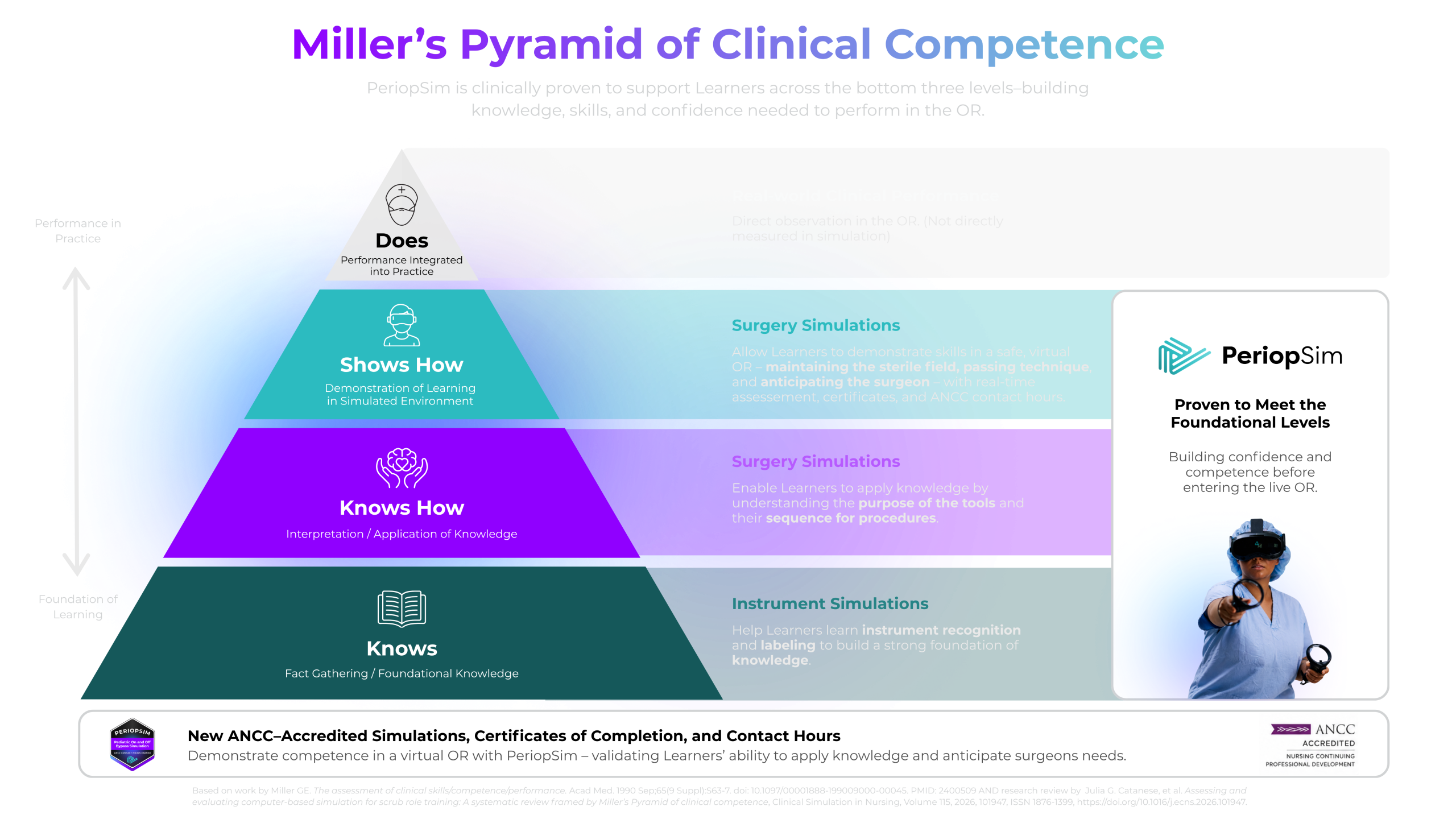
The authors found that none of the included studies evaluated performance in actual clinical practice at the Does level. This remains an important research gap and highlights the need for future studies examining how performance demonstrated in simulation translates into real-world perioperative practice.
The review also identified other limitations in the current evidence base. Assessment validity was limited and inconsistently reported, and none of the included studies involved practicing surgical technologists—limiting the ability to generalize the findings across the full perioperative workforce.
Key Findings
- Computer-based simulation performed comparably to or better than traditional training across the Knows, Knows How, and Shows How levels of Miller’s Pyramid.
- CBS strengthened foundational knowledge, knowledge application, and performance demonstrated in simulated environments.
- Several studies suggest CBS may help slow skill decay and support more durable performance than traditional training alone.
- Computer-based simulation enables scrub role Learners to practice tasks such as instrument handling, sterile field setup, and procedure sequencing outside the live OR.
Continuing the Research
Major Julia G. Catanese, PhD, MSN, RN, CNOR, CHSE, purchased a PeriopSim Research Package from Conquer Experience and has recently conducted additional research including a simulator evaluation framework examining content validity, system reliability, and Learner performance using PeriopSim among more than 100 Nurses and Surgical Technologists across the U.S. Army, Navy, and Air Force.
We look forward to sharing the results of her work following publication.
In the meantime, read Catanese et al.’s systematic review, “Assessing and evaluating computer-based simulation for scrub role training: A systematic review framed by Miller’s Pyramid of clinical competence.”